

During a tense argument, you can calm the room with five simple words: “Did I get you right?” This small question shifts your focus from defending yourself to understanding your partner.
When daily friction wears down relationship communication, partners often stop feeling heard in marriage. Asking this question gives you both a moment to pause before frustration takes over.
Psychologists recommend this reflective check to ease tension and restore calm. It turns a tense showdown into a shared effort to connect.
The Science Behind the 5-Word Question
Psychologists Veronica Hlivnenko, Dr. Brittany McGeehan, Dr. Brandy Smith, and Dr. Avigail Lev recently highlighted this phrase in a report for Parade. They noted that “Did I get you right?” helps you confirm what your partner said before you react.
Dr. Hlivnenko explained that the question signals a real commitment to constructive dialogue. It clarifies key details and lowers emotional doubt.
Even an imperfect summary shows genuine effort, according to Dr. Smith. It helps your partner feel respected and connected.
Research strongly supports this approach. A study by Weger and colleagues in the International Journal of Listening found that active listening makes speakers feel far more understood than quick advice.
When you paraphrase what your partner said and ask for confirmation, you practice true active listening. This step lowers emotional walls right away.
A 2026 study in the Journal of Personality and Social Psychology confirmed that high-quality listening reduces defensiveness during disagreements. It helps people feel supported even when neither person changes their mind.
Why Listening Protects Long-Term Marriages
Listening matters even more as relationships mature. Couples who stay together for decades learn that winning an argument rarely solves the real issue.
The August 2024 Resilient Relationships Study surveyed 1,112 people married 40 years or longer. The researchers found that listening was the single most common strategy couples used to resolve conflict.
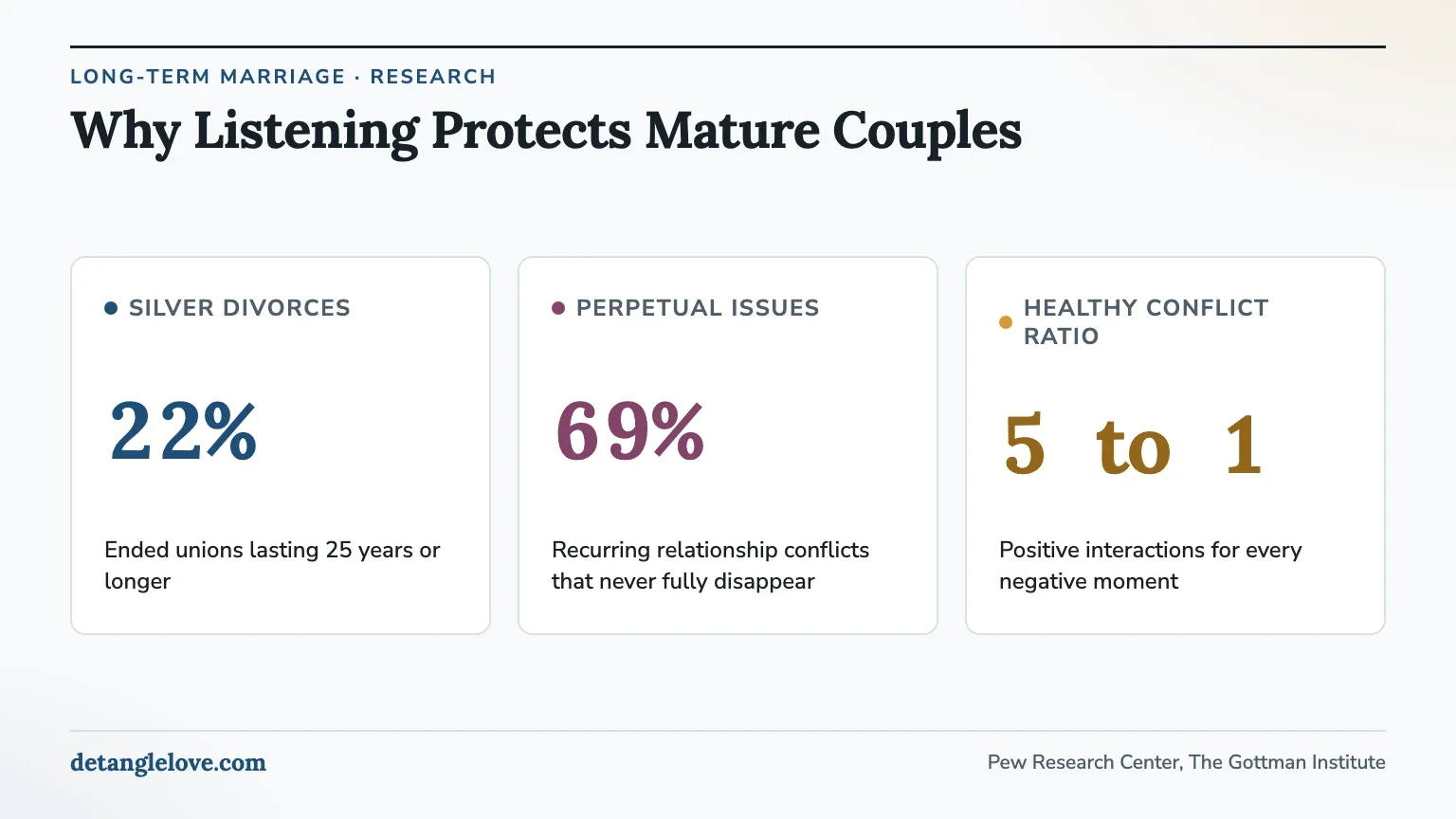
Communication habits carry major stakes for mature couples. Data from the Pew Research Center shows that gray divorce rates remain high, with 22% of 2023 divorces ending marriages of 25 years or more.
Couples aged 50 and older now account for more than a third of all divorces. Often, years of feeling ignored slowly drive partners apart.
Longitudinal studies from The Gottman Institute show that 69% of relationship conflicts are perpetual problems. These recurring issues do not disappear, so partners must learn how to discuss them with empathy.
Gottman also found that stable couples maintain at least five positive interactions for every negative one during conflict. Checking your understanding helps you protect that healthy ratio.
How to Use the Question in Three Steps
Checking your understanding is a core part of clinical conflict resolution, including the mirroring step of the Imago Couple’s Dialogue. You can put this technique to work using three straightforward steps.
Step 1: Summarize what you heard. Restate their main point and the feelings behind it without mocking or repeating them like a parrot.
Step 2: Ask with genuine curiosity. Ask, “Did I get you right?” or “Did I get that right?” Keep your tone warm and open.
Dr. Avigail Lev advises using a gentle tone rather than rapid-fire questioning. A warm delivery makes the question feel like an invitation rather than a test.
Step 3: Welcome their corrections. If your partner says no, do not argue. Let them clarify their thoughts until they feel fully understood.

Why This Question Is Not an Instant Fix
While this 5-word question helps, it is not magic. Psychologists warn that active listening fails when either partner experiences physiological flooding.
Flooding happens when your heart rate spikes and your body enters a fight-or-flight state. When you feel overwhelmed, your brain cannot process complex empathy.
If you or your partner feel flooded, take a 20-minute break before trying to talk. Step away to calm your nervous system, then return to the conversation.
The question also fails if you ask it with sarcasm or eye-rolling. Sincere conflict resolution requires real presence and an open mind.
Checklist for Calmer Conversations
Use this simple checklist during your next disagreement to keep communication respectful and productive:
- Drop your defense: Focus on learning your partner’s view before defending your own actions.
- Summarize the core idea: Reflect their feelings back to them in a calm, clear sentence.
- Ask the 5-word question: Say, “Did I get you right?” with real curiosity.
- Listen to the answer: Allow your partner to correct or refine what you heard without interrupting.
- Take a time-out when needed: Pause the conversation if anger takes over, and return once you both feel calm.
Knowing When to Seek Professional Support
Reflective listening builds stronger bonds, but it cannot solve every issue on its own. Working with a licensed marriage counselor can help you break painful communication patterns.
Please note that communication tools cannot fix an abusive dynamic. If you face verbal abuse, manipulation, coercion, or safety concerns, professional guidance is essential.
You can contact The National Domestic Violence Hotline for free, confidential support at any time. Healthy conflict resolution always begins with safety, mutual dignity, and mutual respect.









Leave a Reply