

Catching yourself thinking about an ex often triggers instant guilt, especially when you are building a promising new romance. You might worry that lingering memories mean you are not fully invested in your current partner.
Recent findings in relationship psychology offer a reassuring perspective on this common experience. Occasional, fond reflections on a previous partner can actually lift your current dating satisfaction.
Rather than signaling unresolved doubt, healthy nostalgia helps you recognize how much you have grown over time. Learning how to process these memories allows you to connect more deeply with the person beside you today.
What the Science Really Says About Nostalgia
Many people assume that any thought of a former love threatens an existing bond. However, empirical research reveals that reflective nostalgia functions differently from active emotional yearning.
A 2026 study published in the journal Emotion by Park and colleagues examined 172 unmarried adults who were dating someone new. Each participant had experienced at least one prior relationship lasting three months or longer.
The researchers randomized participants to write about nostalgic memories of an ex-partner, nostalgic memories of their current partner, or ordinary events from the previous week. Both nostalgia groups reported higher current relationship satisfaction than the control group.
Crucially, reflecting fondly on an ex-partner also heightened participants’ commitment to their current dating partner. Guided, positive nostalgia did not weaken the new bond; instead, it reinforced positive feelings in the present relationship.
Earlier experimental findings also support this pattern. A 2023 study published in the European Journal of Social Psychology by Ai, Gillath, and Landau tested how ex-partner nostalgia influences relationship quality.
Across multiple experiments, reflecting on past romantic memories increased participants’ approach motivation toward their current partner. The researchers discovered that this shift was mediated by a heightened sense of personal self-growth.

Sentimental Nostalgia vs. Lingering Longing
While guided reflection yields positive outcomes, relationship psychology makes a clear distinction between warm nostalgia and unresolved attachment. Understanding this boundary protects both your peace of mind and your partner’s trust.
In a six-month longitudinal study, researcher Tara Spielmann and colleagues found that emotional longing for a recent ex-partner predicted lower relationship quality over time. Active craving keeps you tethered to the past; nostalgia simply acknowledges where you have been.
To determine whether your memories are serving your current connection, evaluate your internal reactions against this simple guide:
- Emotional Tone: Nostalgia brings a bittersweet, gentle warmth; longing sparks acute ache, jealousy, or yearning to rekindle the past.
- Present Motivation: Healthy memories inspire you to invest in your current partner; unresolved attachment drives comparison and emotional withdrawal.
- Sense of Identity: Constructive reflection highlights how much you learned; rumination makes you feel incomplete without your former partner.
- Boundary Clarity: Nostalgic thoughts arise occasionally and fade naturally; obsessive thoughts disrupt your daily routines and intimacy.
When you catch yourself thinking about an ex, pause and check your emotional temperature. If the memory feels like a distant chapter in your story, you are likely experiencing healthy nostalgia.
Applying Nostalgia When Dating After Divorce
This dynamic proves especially relevant when you enter the world of dating after divorce. Long-term marriages shape your habits, preferences, and communication style in lasting ways.
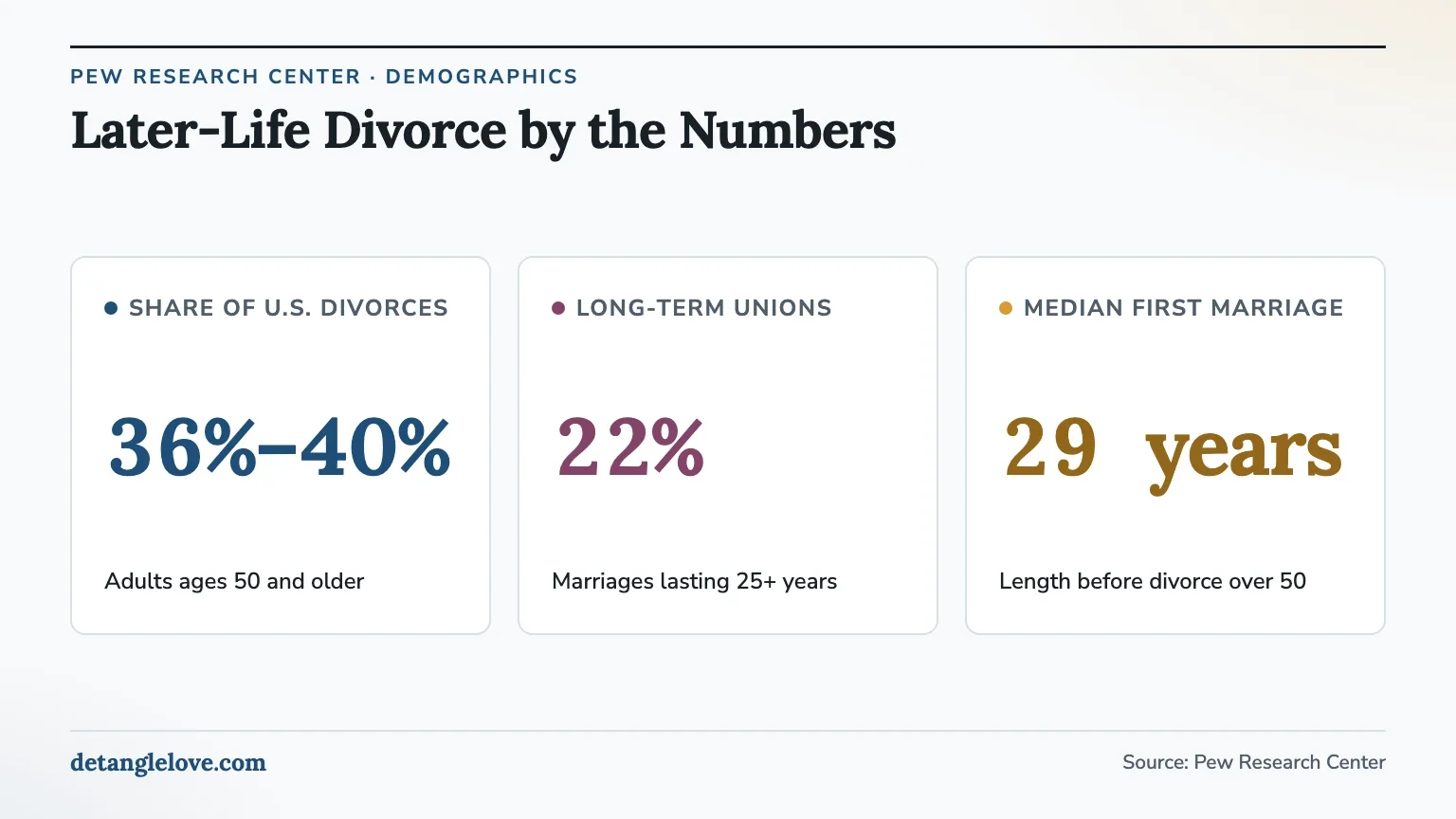
According to the Pew Research Center, adults ages 50 and older account for roughly 36% to nearly 40% of all divorces in the United States. Furthermore, 22% of all 2023 divorces ended unions lasting 25 years or longer.
Among adults over 50 ending a first marriage, the median partnership lasted 29 years. Expecting yourself to erase three decades of shared life is neither realistic nor emotionally healthy.
Senior dating advice often emphasizes starting with a clean slate, but mature love rarely begins on blank paper. Your past marriage taught you how to navigate conflict, manage shared responsibilities, and identify your emotional needs.
Data from Bowling Green State University’s National Center for Family & Marriage Research shows that the divorce rate for adults 65 and older more than tripled between 1990 and 2023. As more mature adults re-enter the dating pool, honoring your history becomes a vital skill.
When you view a former marriage through a nostalgic lens, you can appreciate the happy vacations or quiet companionship without wishing to revive the union. That appreciation helps you bring emotional maturity into your current courtship.
Navigating Memories in Senior Dating
Entering the dating world in later life comes with distinct social dynamics. A Pew Research Center survey revealed that 36% of single adults ages 50 to 64 and 16% of those 65 and older actively seek a relationship or casual dates.
Technology plays a growing role in this search. Industry research from SSRS indicates that 12% of dating platform users are ages 50 to 64, while 4% are 65 and older—with Match and eHarmony leading the category.
Meanwhile, a 2025 AARP study found that 49% of adults ages 50 and older had used a dating site within the prior three years. With so many older adults exploring romance, past relationships frequently emerge in conversation.
Remarriages among adults over 50 face unique challenges, divorcing at twice the rate of first marriages. Integrating past memories constructively can provide the stability you need to sustain a new commitment.
Use your memories as reference points for what worked well and what fell short. This clarity allows you to articulate your preferences clearly to a new partner without carrying resentment or false expectations.

How to Channel Past Memories Constructively
Transforming nostalgic thoughts into current relationship satisfaction requires deliberate practice. You can direct your reflections toward personal growth and deeper intimacy by taking three concrete steps.
First, identify the specific quality behind the memory. If you warmly recall an ex-partner’s patience during a crisis, recognize that you value patience in a companion, and express gratitude when your current partner shows that same trait.
Second, celebrate your personal evolution. Acknowledge how past challenges helped you establish clearer personal boundaries, develop better conflict resolution skills, or learn to communicate your feelings more openly.
Third, convert nostalgic warmth into approach motivation. When a fond memory reminds you of the joy of romance, turn toward your partner with an affectionate gesture, an engaging conversation, or an invitation for an evening out.
Knowing When Reflection Crosses the Line
Nostalgia serves as a healthy tool only when past relationships were safe and respectful. If your memories trigger anxiety, intrusive flashbacks, or persistent grief, they require thoughtful attention rather than casual reflection.
Never romanticize relationships marked by emotional manipulation, abuse, or control. If you have survived an abusive partnership, seeking guidance from a licensed therapist or reaching out to The National Domestic Violence Hotline can provide essential support.
Professional counseling can also help you untangle unresolved grief if memories of an ex cause chronic distress or damage your current partner’s emotional security. Healthy relationships thrive when both partners feel safe, valued, and emotionally available.
By viewing your romantic past as a training ground rather than a missed opportunity, you enrich your current romance. Embracing past memories with perspective empowers you to build a resilient, fulfilling partnership today.









Leave a Reply