
You might be sharing the same bed, bank account, and daily routine, but your spouse likely experiences your marriage entirely differently than you do. Understanding this psychological divide is the most powerful step you can take to bridge the gap and cultivate profound mutual empathy. Sociologists have long documented the phenomenon of the “his and hers” marriage, revealing that men and women often leave the exact same interactions with vastly different interpretations. Whether it is the unequal mental load of household management, the way you each process conflict, or the quiet expectations built by societal conditioning, these invisible differences dictate relationship satisfaction. By identifying these contrasting emotional realities, you can finally transform daily friction into enduring connection.
The Sociological Reality of Dual Marriages
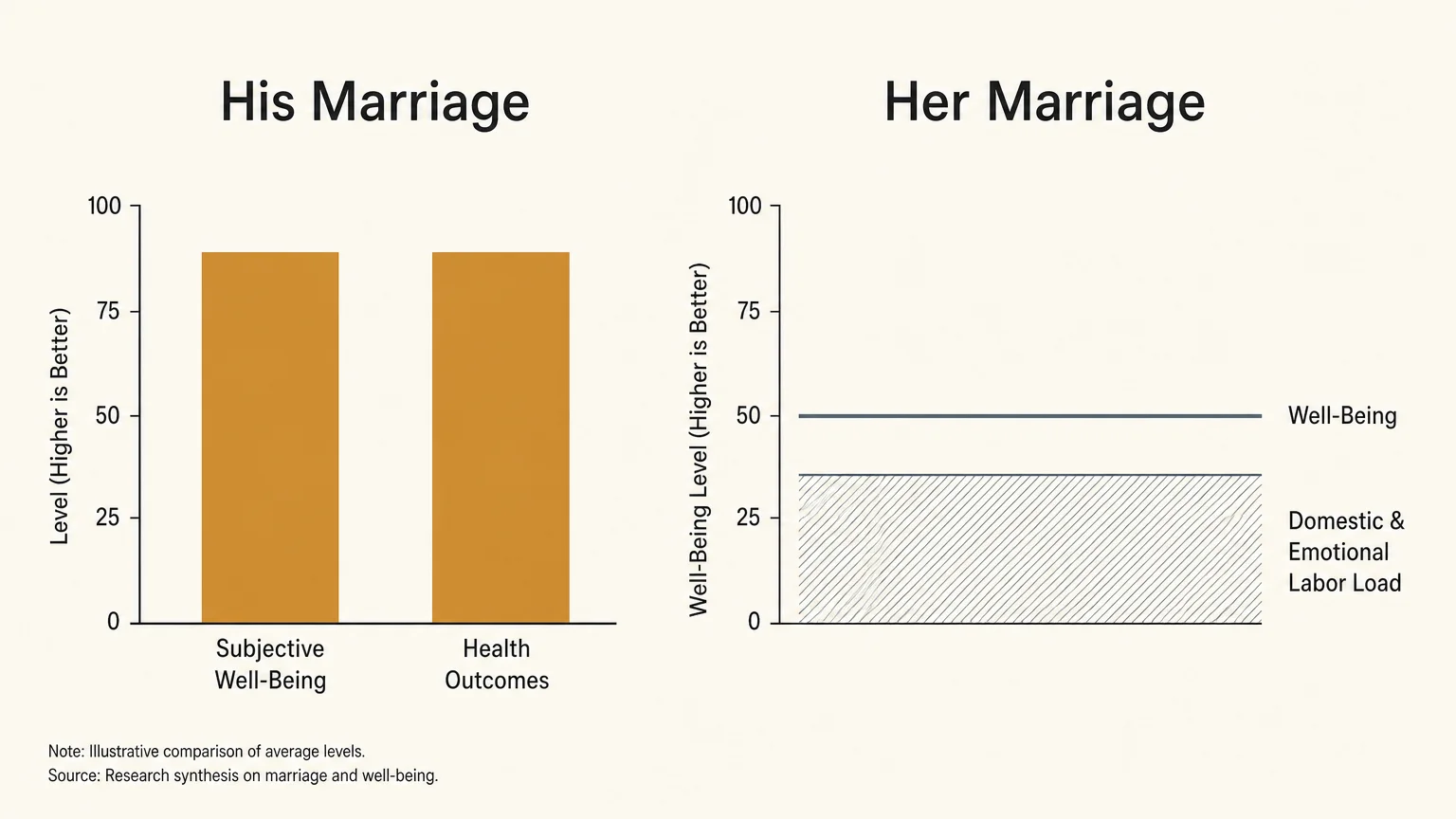
In 1972, prominent family scholar Jessie Bernard introduced a groundbreaking concept: every marital union contains two marriages—”his” and “hers”. Furthermore, she asserted that “his is better than hers”. Decades later, modern research continues to validate this premise, confirming that men and women step into a partnership carrying different cultural conditioning, societal expectations, and physiological stress responses. You cannot solve marital disconnect without first acknowledging that you and your partner are operating from completely different blueprints.
Statistics consistently demonstrate that men experience significant health, wealth, and happiness benefits from tying the knot. Married men often report the highest subjective well-being compared to their single peers. Conversely, women do not always show the same distinct advantage; in fact, unmarried women often report similar or higher well-being than married women. While marriage certainly offers emotional and financial support to both genders, women frequently absorb the bulk of the domestic and emotional labor. This uneven distribution naturally creates a massive divide in how each partner views the relationship.
Consider a typical weekend morning. A husband might look around a quiet living room, see his spouse reading on the couch, and feel a deep sense of marital success and peace. He interprets the lack of active conflict as a thriving, safe relationship. Meanwhile, his wife might be sitting on that same couch mentally cataloging the laundry that needs folding, the groceries required for the upcoming week, and the thank-you notes they still need to mail. She feels overwhelmed and interprets his relaxation as a lack of partnership. You and your spouse can occupy the exact same physical space but inhabit entirely different emotional realities.
To bridge this gap, you must stop assuming your partner experiences the environment the way you do. Ask specific questions about their current stress levels rather than projecting your own sense of calm or chaos onto them. Cultivating curiosity about your spouse’s internal world is the fastest way to realign your perspectives.
How the Mental Load Drives Relationship Psychology
One of the most profound marriage differences centers on cognitive labor—the invisible, continuous mental project management required to run a family and household. Women traditionally shoulder this heavy burden, even when both partners work full-time outside the home.
The mental load is not about physically washing the dishes; it is about noticing the dish soap is running low, adding it to the grocery list, remembering to buy it, and unpacking it under the sink. When a husband tells his wife, “Just tell me what you want me to do, and I will do it,” he firmly believes he is being a supportive, helpful partner. He is offering his physical labor. However, he is inadvertently demanding that she continue acting as the household project manager. She still holds the mental load of delegating the task, which is often more exhausting than the physical chore itself.
This dynamic deeply influences relationship psychology. The partner carrying the mental load eventually feels more like a supervisor than a romantic equal, which stifles intimacy and fosters deep-seated resentment. Simultaneously, the partner waiting for instructions feels micromanaged and unappreciated, wondering why their genuine willingness to help goes unrecognized.
Actionable Insight: Shift your framework from “helping out” to “taking ownership.” If you want to support your partner, claim an entire domain of household management. Do not just offer to cook dinner; take ownership of the Tuesday night meal from conception to cleanup. Plan the recipe, buy the ingredients, cook the food, and wipe down the counters. Complete ownership eliminates the mental load entirely for that specific task, providing true relief for your spouse.

Dissecting Communication in Marriage
Men and women often hit a brick wall during conflict because they use vastly different communication tools. Social conditioning teaches many women to verbalize their feelings to process them, leading them to view discussion as a pathway to resolution. Conversely, conditioning often teaches men to compartmentalize emotions, focusing strictly on immediate problem-solving or withdrawing to regulate their internal physiological stress.
When tensions rise, these differing conflict styles clash violently. A wife might use a “harsh start-up”—beginning a conversation with criticism born out of long-standing exhaustion. A husband, feeling attacked and experiencing an elevated heart rate, might deploy stonewalling to protect himself from the emotional flood. He shuts down, looks away, or leaves the room entirely. She views his withdrawal as blatant abandonment; he views his withdrawal as a necessary de-escalation tactic to prevent an explosive argument.
Relationship experts at the Gottman Institute have extensively studied these patterns, identifying them as the “Four Horsemen of the Apocalypse”. These destructive behaviors include Criticism, Contempt, Defensiveness, and Stonewalling. Over decades of research, Dr. John Gottman discovered that the presence of these four behaviors during conflict predicts relationship breakdown with striking accuracy.
Overcoming these toxic patterns requires intentional, daily practice. Instead of pointing fingers, you must master the gentle start-up. Frame your frustrations around your own feelings and a positive need rather than attacking your partner’s character. Instead of saying, “You never prioritize my schedule; you are so selfish,” say, “I feel overwhelmed managing the calendar this week. I need us to sit down for ten minutes tonight and coordinate our plans.” This subtle shift in your communication in marriage prevents immediate defensiveness and opens the door for productive collaboration.

The Tangible Shift in Intimacy and Connection
Physical and emotional intimacy frequently reveal the starkest contrasts in how men vs women approach connection. You have likely experienced the classic chicken-and-egg dilemma of marital intimacy: one partner needs physical touch to feel emotionally close, while the other needs emotional closeness to desire physical touch.
For many men, physical intimacy acts as the primary vehicle for emotional bonding. It is the space where they feel most accepted, loved, and vulnerable. When a husband initiates physical affection, he is often attempting to bridge an emotional gap and reconnect with his wife after a long, stressful day.
Many women, however, operate on responsive desire. They require emotional safety, a shared workload, and engaging conversation to unlock physical arousal. If a wife feels disconnected or bogged down by the mental load all day, a sudden bid for physical intimacy at night can feel jarring or demanding rather than loving. She needs the emotional connection to precede the physical connection.
Recognizing this core difference is vital for a healthy sex life. If you are the partner who needs physical touch, understand that your spouse’s rejection of an advance is rarely a rejection of you; it is a reflection of their empty emotional tank. If you are the partner who needs emotional connection, recognize that your spouse’s physical advances are often clumsy but genuine attempts to feel close to you. You can break this stalemate by intentionally meeting in the middle. Hold hands, cuddle without the expectation of sex, and engage in meaningful conversation outside the bedroom to build a foundation of mutual trust and affection.

Health, Happiness, and Senior Dating Insights
The disparities in how men and women experience marriage persist—and sometimes intensify—in later life. As couples enter their golden years, retirement, health changes, and empty-nest dynamics force a massive renegotiation of marital roles.
Research published in the Journals of Gerontology indicates that these later-in-life stressors can severely compromise marital well-being, even among couples who have historically maintained strong relationships. Older men often rely entirely on their wives as their primary confidantes and social coordinators. When men retire, they may look exclusively to their spouses for daily engagement, transferring their entire need for purpose onto the marriage.
Conversely, older women typically maintain broader social networks filled with friends, adult children, and community groups. A wife might feel entirely suffocated if her newly retired husband suddenly depends on her for all his social and emotional needs. Establishing independent hobbies and separate social outlets is absolutely critical for older couples to maintain a healthy balance.
For older adults navigating senior dating or entering a new marriage later in life, acknowledging these historical gender dynamics will save you immense heartache. You bring decades of lived experience and firmly set routines into a new partnership. Discuss your expectations for independence, caregiving, and social engagement early on. Do not assume your new partner wants to replicate the dynamic of your previous marriage.

Actionable Marriage Advice to Realign Your Perspectives
Bridging the gap between “his” and “hers” marriage requires deliberate, consistent action. You cannot expect profound psychological shifts to occur organically; you must build intentional systems that enforce mutual empathy and shared responsibility.
Implement the following checklist to synchronize your marital experiences and foster a deeper connection:
- Schedule a Weekly State-of-the-Union: Dedicate twenty minutes every Sunday to discuss the upcoming week. Review schedules, financial obligations, and meal plans. This neutralizes the mental load by making household management a visible, shared agenda rather than a hidden burden.
- Conduct a Chore Audit: Sit down together and write out every single task required to keep your life running—from paying the mortgage to scheduling the dog’s vet appointments. Divvy up the list based on complete ownership, not just physical execution.
- Establish a Decompression Buffer: Give each other twenty minutes of unstructured downtime immediately after returning home from work. This buffer allows you both to regulate your nervous systems before tackling evening household demands.
- Practice Emotion Coaching: When your partner brings you a problem, do not immediately offer a solution. Ask, “Do you want me to help you solve this, or do you just need me to listen?” Validation must always precede problem-solving.
- Study Your Partner’s Stress Signals: Notice how your spouse acts when they are overwhelmed. Do they get unusually quiet? Do they start micromanaging the kitchen? Recognize these specific behaviors as cries for support rather than personal attacks against you.
- Prioritize Non-Sexual Touch: Foster an environment of physical safety and warmth. A hand on the shoulder, a prolonged hug, or sitting close on the couch builds a physical connection that does not carry the pressure of sexual performance.

Recognizing When Differences Mask Deeper Safety Concerns
While miscommunications, unequal household burdens, and clashing conflict styles are incredibly common marital challenges, they must never be confused with toxic, manipulative, or dangerous behavior. It is one thing to feel misunderstood; it is entirely another to feel fundamentally unsafe, manipulated, or controlled in your own home.
Healthy relationships are firmly anchored in mutual respect, even during the most intense disagreements. If your partner uses their physical size to intimidate you, restricts your access to finances, isolates you from your friends and family, or weaponizes your deepest vulnerabilities against you, you are no longer dealing with a simple communication gap. These are glaring signs of coercive control and emotional abuse.
Furthermore, chronic marital distress can take a severe toll on your mental and physical health, leading to crippling anxiety, profound depression, and severe isolation. In some cases, severe marital conflict involves individuals with high-conflict personalities or Cluster B traits, which feature extreme vindictiveness, intrusiveness, and an inability to care about the needs of others. If your relationship is consistently draining your will to engage with life, individual therapy can help you regain your footing and assess your reality objectively. Organizations such as the American Psychological Association offer extensive resources on recognizing healthy relationship boundaries and identifying clinical distress.
If you ever fear for your physical safety, or if you are experiencing severe emotional distress and coercion, seek professional help immediately. You can reach out to the National Domestic Violence Hotline for confidential, immediate support and safety planning. No amount of communication advice can fix an abusive dynamic; your physical well-being and emotional safety must always remain your absolute highest priority.